


AI at work

Procurement and Warehouse
Surging energy prices? Raw material shortages?
Price volatility? Logistics bottlenecks?
Sapiens Analytics’ on-demand solutions
enable efficient warehouse management,
minimize the risk of product unavailability,
cut procurement costs, and eliminate excess inventory.
Forecasting raw material costs
Control price fluctuations
Forecasts based on traditional inventory management strategies fail to yield accurate results. Analysts often have to manually adjust purchasing decisions based on their own knowledge and experience.
Sapiens Analytics’ AI solutions offer predictive models capable of anticipating the availability and pricing of raw materials and components. These solutions accurately forecast cost fluctuations and assist managers in determining the optimal timing for placing purchase orders by leveraging a wide range of relevant variables.
Specifically, Sapiens Analytics provides a predictive overview of raw material availability and prices by monitoring both the macroeconomic news that influences costs and market trends, while tracking key indicators such as Stochastic, MACD, and RSI.

Forecast raw material availability
Supply stability

Sapiens Analytics solutions monitor the various factors driving high volatility in the commodities market—such as supply and demand, market prices, transport costs, currency fluctuations, and weather conditions.
By integrating external data with internal company data and analysing historical trends, we build a model that ensures consistent supplies for you from the very start.
You will also achieve verifiable operational savings that continue to improve over time, thanks to machine learning.
That is why we are the most effective solution for defining your raw material procurement strategies.
Warehouse optimisation
Control demand variability—and more.
Machine learning reduces inventory costs by at least 10% compared to conventional methods.
Sapiens Analytics provides a continuously improving forecasting framework that supports the company in managing procurement.
Machine learning applied to inventory management enables the precise and in-depth calculation of optimal parameters for each item, eliminating human error. This results in more accurate forecasts, a reduced risk of stockouts, higher fulfilment rates, and greater customer satisfaction. Furthermore, machine learning algorithms help strike an optimal balance between minimising inventory costs (freeing up capital), minimising losses due to stockouts, and minimising ordering costs through bulk purchase discounts.


The risks of poor warehouse management


Innovate with us
To put artificial intelligence to work in managing your company's procurement, it is essential to first define the existing business problem before exploring how AI can solve it.
Failing to complete this step will yield results that fall short of AI's immense potential.
The following examples demonstrate the value of artificial intelligence in increasing process efficiency and reducing costs.
1
Which items need to be ordered, and how many?
At what price?
2
What is the best time to order?
3
What is the optimal amount of inventory?
4
What is the total cost of warehouse management?

Initial data

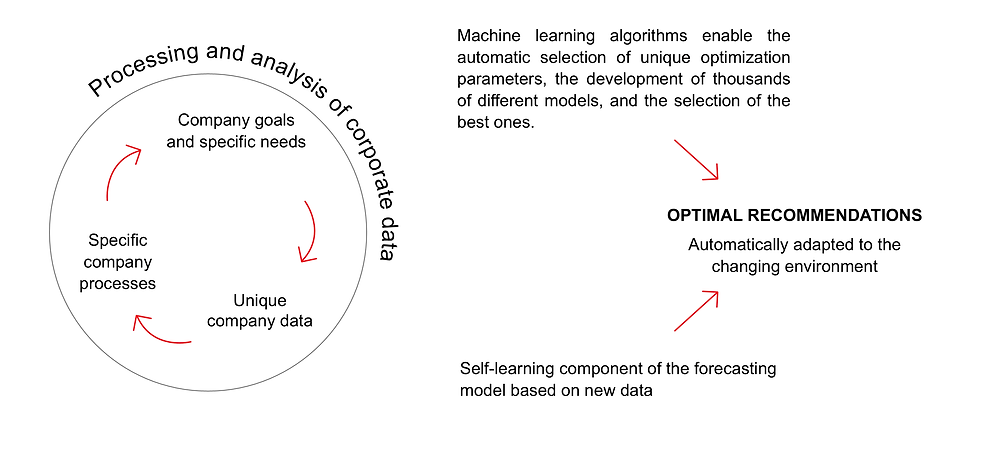
The key to effective warehouse management is an advanced machine learning solution based on enriched internal and external business data.
The parameters for forecasting warehouse item demand are automatically selected based on unique business data. Ideally, historical data from the previous three years should be analysed; this data then serves as the dataset for building the machine learning model, enabling the identification of seasonal patterns and the generation of accurate forecasts.
Warehouse optimisation
Phases
DATA ANALYSIS
Sales analysis, cancellation analysis, delivery route analysis, identification of seasonal factors and trends, analysis of stock shortages, identification of inventory build-up, identification of data correlation patterns, anomaly detection.
DEVELOPMENT OF A
RECOMMENDATION MODEL
Development of an optimisation model that minimises inventory costs by recommending the necessary order quantities and appropriate suppliers.
1
3
2
4
DEVELOPMENT OF PREDICTIVE MODELS
Demand forecasting, shipping times, insurance coverage levels, and other probability-related factors that significantly impact storage costs.
IMPLEMENTATION
Development of the user interface and/or integration with related systems for transmitting modelling results.
The benefits of Machine Learning
Development of predictive models
Conventional management
-
The formula for estimating order periods and origins is created by a human being.
-
The formula is based on corporate data, including data dating back decades.
-
The formula's structure is rigid: it does not take into account the client's specific business characteristics, nor is it modified as the market evolves.
-
The formula is the same for all types of warehouse items.
AI-optimised management
-
The formula for estimating order timeframes and origins is created by ML algorithms.
-
The formula is based on generalised customer data from the last 2–5 years.
-
The structure of the formula is defined during the model's learning process using the client's data, and is modified if the market changes.
-
The formula may differ for the various warehouse items.
Substantially lower labor costs
Lower risk of goods being out of stock
Higher and faster inventory turnover
Better Customer service
Increase in profitability
Reduced inventory surplus
Lower warehouse operating costs
Greater customer satisfaction
Insights


